Thursday, April 23, 2015

kyllen climate change


Over the past century people burning fossil fuels have released large amounts of carbon dioxide and other greenhouse gases into the atmosphere. The majority of greenhouse gases come from burning fossil fuels to produce energy,although deforestation,industrial process,and some agricultural practices also emit gases into the atmosphere.


Greenhouse gases act like a blanket around earth,trapping energy in the atmosphere and causing it to warm.This phenomenon is called the greenhouse effect and is natural and necessary to support life on earth.However, the buildup of greenhouse gases can change earth's climate and result in dangerous effects to human health and welfare and to ecosystems.

Tierens I'm tiered not tiered

Tierens energy stuff

The great pacific garbage patch
The great pacific garbage patch is in the Pacific Ocean
This garbage patch is the king it could be bigger than a USA state

BlablaπŸ˜€πŸ˜…πŸ˜πŸ˜†πŸ˜‚πŸ˜‡πŸ˜ƒπŸ˜ˆπŸ˜„πŸ‘ΏπŸ˜‰πŸ˜πŸ˜ŠπŸ˜Ž☺️πŸ˜πŸ˜‹πŸ˜πŸ˜ŒπŸ˜‘πŸ˜’πŸ˜—πŸ˜“πŸ˜˜πŸ˜”πŸ˜™πŸ˜•πŸ˜šπŸ˜–πŸ˜›πŸ˜œπŸ˜‘πŸ˜πŸ˜’πŸ˜žπŸ˜£πŸ˜ŸπŸ˜€πŸ˜ πŸ˜₯

energy can be solar power and wind power and fossil fuels.
    "Deep water horizonoil oil well that blew up It Happened 2010 it spilled 2700 tanks of oil. Oil and water do not like echuther😒 soon fossil fuels will sun out that's why we have solver power and wind power. Hello

Monday, April 13, 2015

Ara's Info About Glaciers

                                               Glaciers

Glaciers form over a lot of years when snow and ice build up faster that snow and ice is removed. The rom all of snow and ice is called ablation and includes the process of melting and evaporation. 

When individual snowflakes are crushed by the immense weight pressure, air is squeezed from the snow turning into a very dense glacial ice.

Researchers are able to find out the direction of historical glaciers by observing bedrock scrapings such as glacial straitions and chatter marks.

As glaciers move they erode the terrain beneath the while using 2 main processes. Plucking, whereby bedrock is softened and levered out by subglacial water constantly re-freezing (expanding) within  it, the sediment then becomes part of the glacier's cargo. Abrasion happens when the ice and now rock also slides over the bedrock essentially smoothing and polishing.

Studies of glacial deposits also help show where historical glaciers were and how the moved. Linear mounds of glacial sediment called moraines are formed and left by the deposition of material from glaciers. While drumlins are teardrop shaped groups of hills also containing left behind sediment deposits.

The study of glaciers is very important for scientists to keep track of unique variations in the Earth's climate as glaciers are very sensitive to climatic changes. 

Friday, April 10, 2015

Bryce's erosion

volcanos

  They erupt and when they do they Spew hot magma also called lava, which destroys everything in its path.  Its about 3000 degrees F I know crazy isn't it. Lava hardens into obsidian granite and  basalt


Tectonic plate's shift and cause earthquakes, volcanos  to erupt, and cause massive avalanches.


Wednesday, April 8, 2015

Ara's Info about Earth's Structure

Science

                                                               What we learned in class

Glaciers: permanent masses of ice and snow that move more than 10% of Earth's land. Antarctica, Greenland, and North Pole

Formation: cold places------ don't melt
New snow packs the old snow down. 
- great accumulated weight makes glacier move.
- maybe altitude melt water under glacier
Pushes through mts. polishes/ smoothes out. 

                                          Earth Structure

Lithosphere: The lithosphere is a solid surface surrounding the earth. The lithosphere is a cool crust that surrounds the liquid and solid interior of Earth. 

The rock plates that float across the surface of Earth are called tectonic plates. The plates float above the mantle, an area in between the core and the solid.  It is a very important solid that can deform and move. It's very hot, but not hot enough to be a liquid rock. There are places where magma seeps to the surface, but that mantle in basically a plastic-like solid that can slowly swirl and move around the planet.

Liquid and Solid core: The core has 2 different regions. The liquid outer core and a solid inner core.
Both layers and made up of iron and nickel. The inner core is a giant furnace at super hot temperatures and pressures. The flowing metal of the outer core helps create a dynamo effect. In case of the Earth, the magnetic field protects our planet from space, solar wind, and solar radiation.

Scientists have discovered that the pressure and temperature increase as you move towards the center of the planet. The outer core of the Earth has very hot temperatures and extreme pressures that keep iron and nickel in a liquid state. The mantle has a range of 500 to 4,000 degrees Celsius. Room temperature is about 23 degrees Celsius.

                                                                  Earth Structure: Tectonics

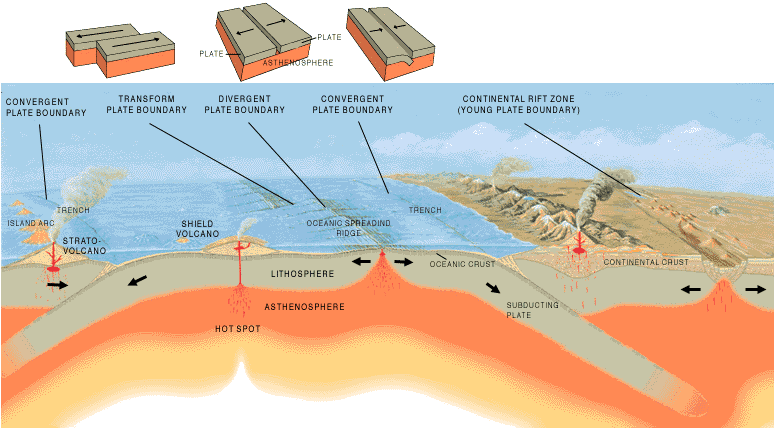
Tectonic plates make up the top layer of the Earth named the lithosphere. Directly under the lithosphere is the asthenosphere. There is an on-going heat and radiation given off from the core of the Earth. The tectonic plates are floating above the molten rock and moving around the planet. When the plates and continents and plates move it's called continental drift.

Think of the molten rock in as the asthenosphere, not as rock, but as a liquid. It has currents and flows like any normal liquid. When the tectonic plates spread apart, it's called a spreading center. When the tectonic plates move closer together, it's called a subduction zone. When the tectonic plates are forced together, it called a zone of convergence. If plates move down into the asthenosphere the plates begin to melt.

Scientists have traveled all over the world and found evidence that supports the ideas of plate tectonics. Did you ever notice that South America and Africa look like the go together. South America, Africa, and all the other continents went together to make one gigantic continent called Pangea. But, because of tectonics plates around the world, Pangea was split apart into smaller separate continents.